
Fabelisme began in the early 2000s as an exploration of human behaviour through imagined relationships between nature, technology, society, and the environments we create.
Animals, machinery, architecture, landscapes, and human traces merge into hybrid forms, allowing each drawing to examine a different condition—from technological acceleration and social change to digital communication, belief, mortality, and the realities people construct around themselves.

Kura-kura
graphite on paper
graphite on paper
2004
Kura-Kura reflects on the pressure of rapid development and technological change on communities whose lives move at a very different rhythm.
The tortoise becomes a metaphor for people whose livelihoods are rooted in agriculture, yet who are increasingly expected to carry the infrastructure, technology, and demands of urban progress. Electric poles, cables, monitors, and working figures accumulate across its shell, turning the idea of advancement itself into a burden.
The work questions what happens when the image of progress begins to matter more than the people expected to live within it.
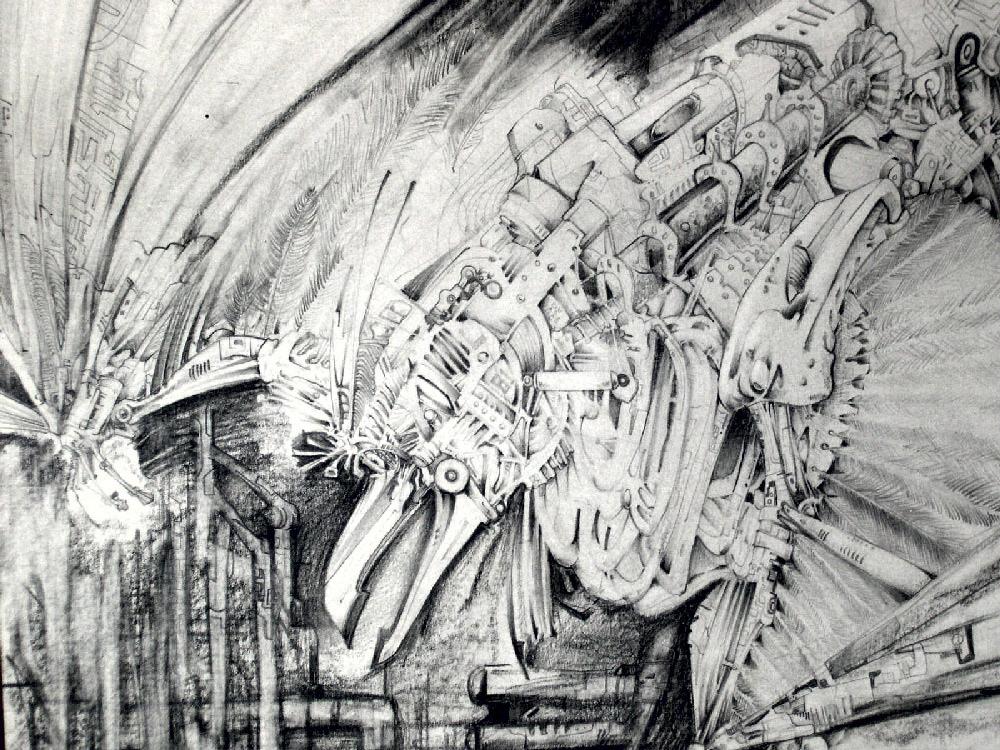
Bird Machine
graphite on paper
2003
A parrot-like machine becomes a metaphor for a world in which everyone appears increasingly able to speak, connect, and make themselves heard.
Yet its wings are mechanical. The contradiction questions whether greater communication necessarily brings greater freedom, or whether expression can still take place within systems that quietly define its limits.
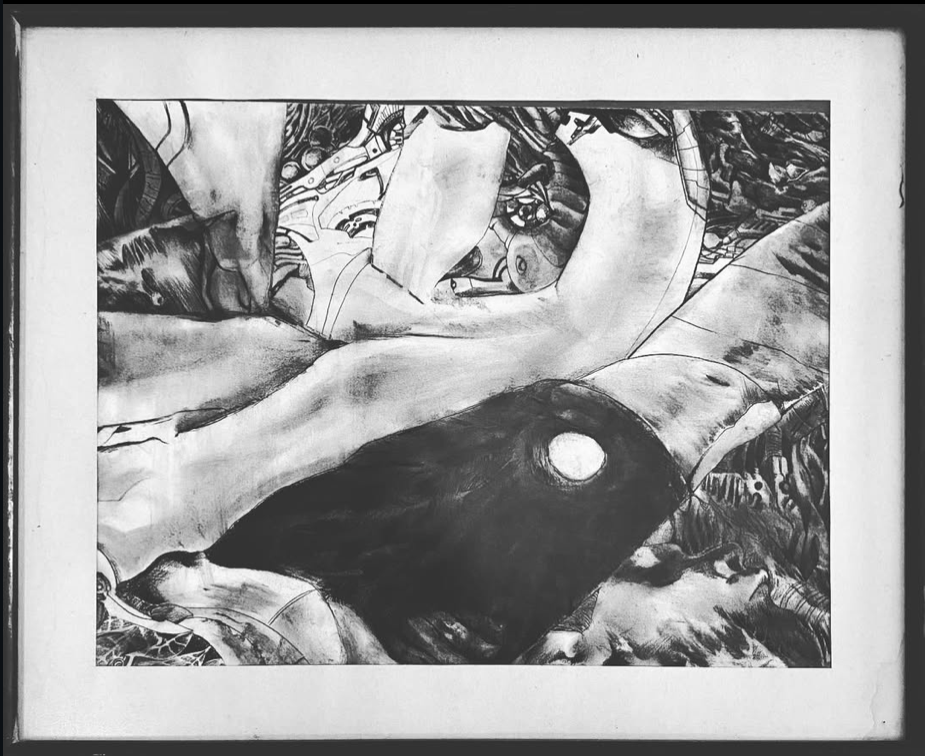
Lost in the Web
Charcoal on paper
2004
Lost in the Web reflects on connectivity becoming entanglement.
The network offers communication, information, and access, yet it can also surround the individual so completely that identity, attention, and meaning become difficult to separate from the system itself. The crow introduces an element of ambiguity
neither entirely positive nor negative
within an increasingly interconnected world.
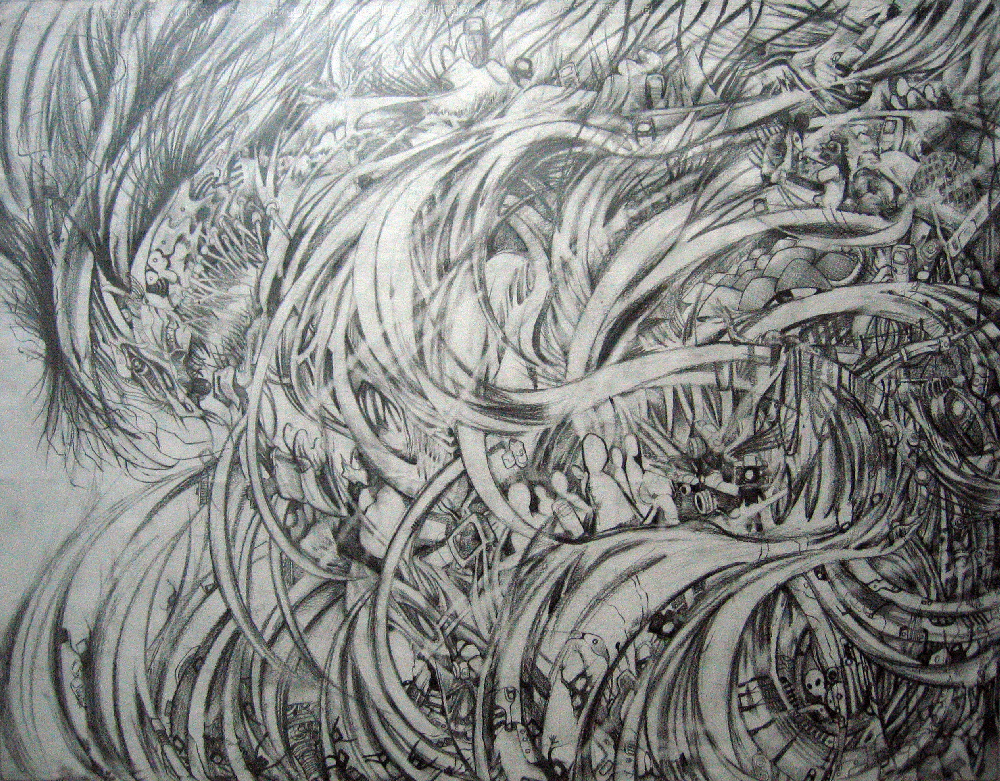
Guruh Gemuruh
Graphite on paper
2004
Guruh Gemuruh depicts a moment of social and geopolitical tension before catastrophe. Competing claims of authority, media attention, public spectacle, and people seeking visibility are drawn into a landscape about to be overwhelmed by something far greater than themselves.
For me, the approaching catastrophe also carries a spiritual resonance, not as a literal explanation of disaster, but as a reminder of how quickly human ambition, conflict, and spectacle can become insignificant when confronted by forces beyond our control.

Flat - Tortoise
Graphite on paper
2020
Inspired by the old image of a world resting on the back of a tortoise, Flat Tortoise explores how an impossible idea can begin to feel convincing when it is presented through beauty, familiarity, and repetition.
The tortoise’s shell gradually merges with the concealed form of a human palm. Its fingers and lines disappear into a peaceful landscape of water, waterfalls, and gentle ripples, allowing the viewer to enter the image without immediately recognising the structure shaping it.
Beneath this calm surface, exposed roots reveal an unstable foundation. The work reflects on how constructed realities can begin to feel natural when the mechanisms shaping perception remain partly hidden.

Looking back, these works also reflect an approach that continues to shape my practice today: paying attention to the social, cultural, technological, and human contexts surrounding an image before translating them into visual form.
For me, illustration is not only about how an image looks, but also about understanding what it is trying to communicate.